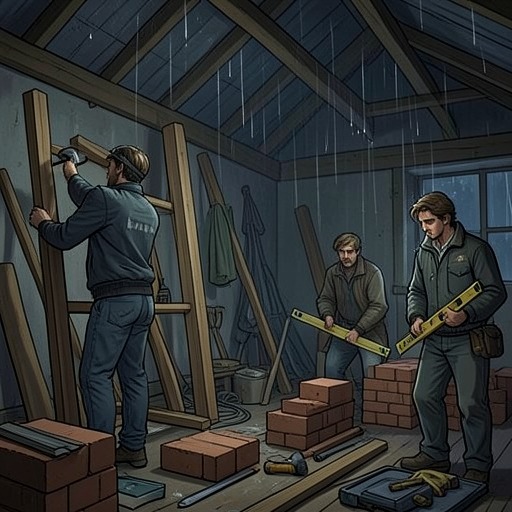
Shelter, Roof, and Foundation
The Wife He Never Wanted: A Marriage-In-Crisis Billionaire Romance (Second Chance Billionaires)“Shelter, Roof, and Foundation” names the book’s governing motif of physical refuge, structural responsibility, and emotional repair. Harbor Street’s roof first reveals how long-term neglect can turn an occupied shelter into a danger, but the later building becomes more than a replacement facility. Designed with Paige Templeton and Claire’s requirements, protected from Caldwell branding and control, and filled with animals and families, it embodies a form of rebuilding in which a sound foundation matters as much as an impressive roof. The same principle governs Paige Templeton and Maddox Caldwell’s conditional reconciliation: love becomes credible only when it is supported by sustained work, boundaries, and a structure Paige can help design and choose.
The Shelter as an Exposed Structure
The motif begins when Maddox Caldwell returns regularly to Harbor Street Shelter rather than treating it as a single charitable appearance. During his shifts, he learns the dogs’ names, the volunteers’ schedules, and the practical details of the shelter’s work. On his fourth shift, he sits on the concrete floor of Skipper’s run without reaching toward the dog. Skipper eventually crosses the space and lies nearby, establishing trust through proximity rather than capture or performance. From that low position, Maddox notices the roofline above the kennel.
His professional training makes the building’s deterioration legible. The corner above Skipper’s run has a sagging fascia and a stain running down the block, evidence that water has been entering for some time. Maddox recognizes a failing load path rather than a merely cosmetic defect: the structure is moving toward serious danger. The knowledge comes from the construction world associated with his family, but its moral use is different here. He cannot repair the marriage by force, yet he can respond to a roof that is beginning to fail. The shelter therefore becomes a test of whether expertise will remain a tool of acquisition and control or become a form of care.
Maddox tells Claire that the east-run roof needs an updated assessment and offers to send a structural engineer from Caldwell at his own expense, without his name attached, publicity, or strings. Claire explains that an inspection had already flagged the issue the previous year as repair-needed rather than condemned, but that Harbor Street had been patching leaks while pursuing a capital grant. Her formulation that the list was longer than the budget identifies the institutional vulnerability beneath the visible roof damage: the shelter’s danger results not from one villainous act, but from chronic need, deferred maintenance, and insufficient resources.
Collapse and Emergency Refuge
The warning becomes an immediate crisis when the east-run roof collapses during a storm. It is the same corner Maddox had flagged after seeing it from Skipper’s kennel. The collapse takes part of the intact wing with it, sends water into the main kennel room, and leaves Claire with thirty animals to move within an hour while emergency boarders and veterinary clinics are already full. The storm exposes the consequences of the earlier structural risk, but it also produces a rapid network of action: Claire directs the evacuation, Paige arrives to help, and volunteers move frightened dogs, cats, and puppies through ankle-deep runoff.
Paige’s understanding of the danger is sharpened by Skipper’s absence from the ruined run. While driving through the rain, she realizes that the collapsed section was the kennel where Skipper had lived for more than a year. Had Maddox not spent four shifts sitting with him and then taken him home days before the collapse, the dog would probably still have been there. Skipper’s adoption thus becomes part of the shelter’s structural story: a private act of attachment has unexpectedly removed one vulnerable animal from the path of disaster, even though the remaining animals still face the emergency.
Maddox responds without turning the rescue into a scene for Paige or the public. Caldwell trucks arrive with workers in rain gear, and Maddox goes first to Claire, who is running the evacuation, asking what she needs and doing exactly that. Paige sees him hauling crates in the rain like any other member of the line. There is no press and no gesture engineered for her to witness. When the Caldwell development opens its unfinished lobby, utilities and heat provide temporary refuge for the displaced animals. The shelter’s function survives in a provisional form: crates, blankets, wet animals, and exhausted workers occupy a space whose walls hold while the storm continues outside.
The image of Maddox holding a shivering terrier mix against his chest reinforces the distinction between public rescue and unobserved labor. He is already holding the dog when Paige finds him near midnight, so the tenderness cannot be dismissed as an attempt to impress her. The emergency shelter is therefore both literal and ethical. It protects animals from the weather, while Maddox’s conduct demonstrates a new willingness to serve a need without demanding recognition in return.
From Failed Roof to Designed Foundation
A week after the storm, the animals are safe but homeless, and Harbor Street cannot reopen in its old building. The insurance settlement covers water damage but excludes most of the structural failure because the corner’s preexisting deterioration had been flagged; code upgrades are also excluded. Reopening requires a modern-code rebuild rather than a simple repair, and the cost exceeds what the shelter has ever possessed. The old site had already been cramped and unable to hold Harbor Street’s needed capacity. The collapse therefore changes the question from how to restore the past to what kind of institution should replace it.
Maddox brings the problem to the Templeton kitchen table with Claire present. He does not arrive with flowers or finished plans. Instead, he brings a cardboard tube, a laptop, preliminary feasibility sketches, three possible sites, zoning and access notes, flood-plain data, and construction figures backed by a Caldwell commitment. Most importantly, he brings a largely blank program-requirements template listing intake capacity, an isolation ward, quiet rooms, and community space. The unfinished document is a structural symbol: Maddox can provide building knowledge, land, money, and a crew, but he does not presume to decide what the shelter needs.
He tells Paige Templeton and Claire that he knows buildings but does not know shelters, and asks them to specify every room, run, and long-denied function before he draws another wall. Claire immediately begins designing the facility aloud, naming a real quarantine wing with separate air handling and a community room large enough for indoor adoption events. Paige recognizes that the solution places the pen in her hand rather than taking it away. The new foundation is therefore participatory. It is not simply Caldwell construction transferred to a charitable cause; it is a structure whose use, layout, and purpose are determined by the people who understand Harbor Street’s work.
Boundaries, Ownership, and Rebuilt Intimacy
The shelter’s governance becomes inseparable from the marriage’s repair. The merger remains dead, and the reconstruction rules are put in writing. The land and finished building will be deeded to Harbor Street’s nonprofit, carry no Caldwell name, and contain no strings that outlive Maddox’s checkbook. Paige and Claire will be able to run the organization whether or not Paige ever wears Maddox’s ring again. This arrangement converts a grand offer into a bounded commitment. Maddox supplies resources without purchasing authority, access, or reconciliation.
That distinction answers the earlier pattern in which material gestures could threaten Paige’s agency. The rebuilt shelter is not proof that Maddox has regained the right to determine Paige’s life; it is evidence that he can support a structure that remains hers to govern. David Templeton, who has taken two stiff phone calls from Maddox and later asks his opinion about a drainage problem, remains part of the practical world around the project without the merger being revived. Paige still sleeps at her father’s home when she wants distance, and Maddox does not pressure her. Their relationship now depends on naming old habits when they appear instead of allowing silence to rot beneath them.
The motif reaches its most intimate expression in a smaller domestic scene. When Skipper wrecks a pillow, Maddox reaches for the dog before the fabric and treats the object as replaceable while treating the animal as singular. The gesture recalls the earlier moment when a muddy dog in a white room exposed the failure of their marriage. Maddox now chooses the dog, the ruined rug, and Paige on the floor over a perfectly clean house with no one in it. The emotional foundation is not a speech announcing transformation; it is repeated behavior in ordinary messes, without an audience and without requiring Paige to certify that he has changed.
The New Harbor Street
The rebuilt Harbor Street opens on a Saturday in October, and Skipper is the first dog through the door. Paige places his old torn ear in the organization’s logo, while Claire and Maddox share knowledge of the history behind that small image. The name Harbor Street also survives the collapse. Claire regards a name that endured two decades and one roof failure as more valuable than a name attached to a check, and Maddox supports her decision without argument. Continuity is preserved, but it is not a return to the unsafe old structure.
The completed building realizes the requirements Claire named at the Templeton kitchen table. It has separate air handling for the isolation ward, a real quarantine wing, and a community room large enough for indoor adoption events. Families move through rows of animals beneath walls that hold and a roof that no longer requires prayer when the sky darkens. The facility’s physical improvements represent a shift from emergency survival to durable institutional care: the new shelter is designed for the animals’ needs rather than patched around a failing past.
At the opening, Paige stands with a clipboard while work continues around her. Maddox leaves room in the east footprint for a future extension, but only whenever Paige decides. Her timeline and her building remain hers, even as Claire continues as director and Maddox works beside her. Skipper then finds a patch of afternoon sun on the new concrete and falls asleep with his torn ear turned inside out. His undignified rest completes the motif: the dog once exposed to a collapsing roof now occupies the center of a sound refuge, while his presence also marks the relationship’s newly solid foundation.
The final image joins practical labor and emotional permanence. Paige crosses the floor to join David over a drainage plan, adds her own opinion, and Maddox follows. Behind them, Skipper snores in the sun as Harbor Street continues around them, offering refuge to animals who will pass through in the years ahead. The phrase “Walls holding, roof sound” describes the rebuilt facility, but it also expresses the book’s condition for reconciliation. A home and a marriage can endure only when their foundations are maintained, their occupants are protected, and the people who live within them retain the authority to shape what is built.